Technological advancements–specifically the creation of email and text messaging–have led to letters becoming less prevalent in today’s society. Furthermore, the online format lacks many benefits that accompany the physical letter format:
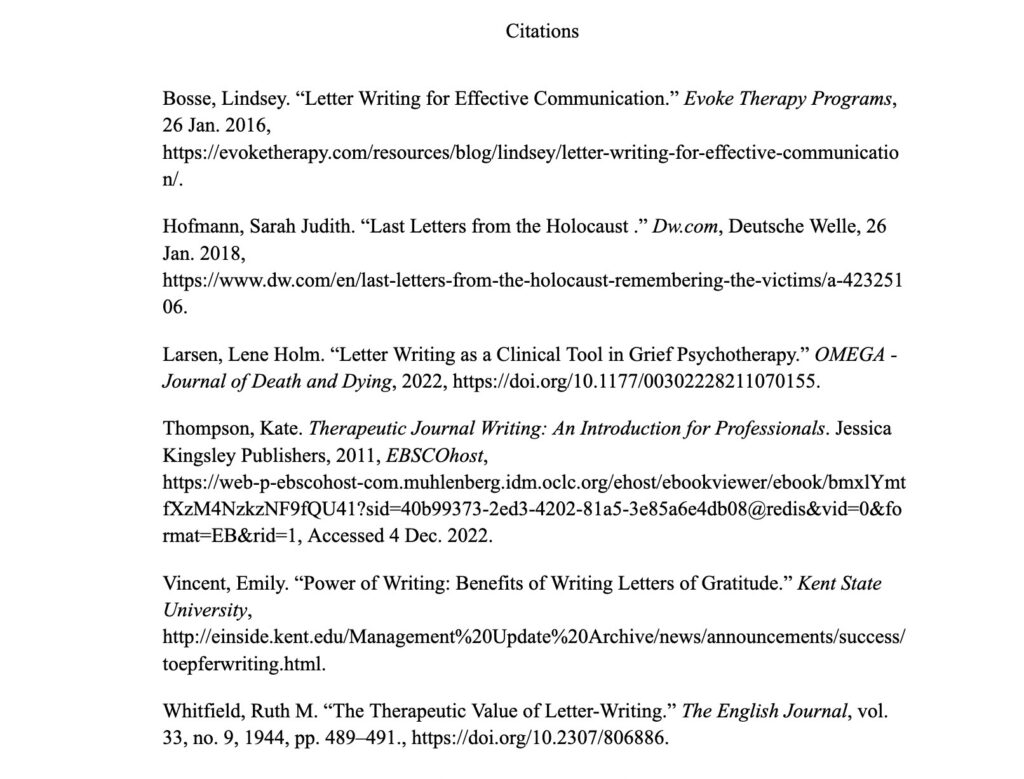
“Letter writing has been shown to stimulate the mind in ways that other types of communication lack” (Bosse).
https://evoketherapy.com/resources/blog/lindsey/letter-writing-for-effective-communication/
Receiving a physical letter, rather than a text message or email, could likely lead to the person feeling more emotions. However, the person receiving the letter is not the only one who has a valuable experience from it–the person who writes the letter obtains a worthwhile benefit as well. Letter writing can be a useful tool in navigating emotions because it can serve as an outlet to express and explore feelings.
Among the many different types of letters (open letters, historical letters, love letters, etc.) thank you letters are arguably one of the more popular forms of letters in today’s society. Although the recipients of thank you notes may deal with them in many ways, a thank you note written from the heart will almost never bring about a negative reaction. Discerning the impact of such letters on the sender is a more complex matter. Steve Toepfer, an associate professor at Kent State University, conducted a study to evaluate if there are benefits to the authors of thank you letters. In particular,
“the study examined the effects of writing letters of gratitude on three primary qualities of well-being: happiness (positive affect), life satisfaction (cognitive evaluation) and depression (negative affect)” (Vincent).
http://einside.kent.edu/Management%20Update%20Archive/news/announcements/success/toepferwriting.html
The study was made up of two groups: an experimental group and a control group. While each group filled out a questionnaire about their well-being, only the experimental group wrote thank you letters. The well-being of the control group stayed the same, but that of the experimental group improved. Toepfer states that
“‘the new and potentially important finding is that depressive symptoms decreased. By writing these letters–15 to 20 minutes each, once a week for three weeks to different people–well-being increased significantly’” (Vincent).
http://einside.kent.edu/Management%20Update%20Archive/news/announcements/success/toepferwriting.html
These findings suggest the power thank you letters can have–not only on the receiver, but the author as well.
Evidence drawn from many scenarios confirms the potential potency of letter writing as a means of managing one’s psychological state and emotions. In a journal article written by Ruth M. Whitfield, we see the positive effects of letter writing on a class of students struggling in school. The classroom was made up of high schoolers who failed English composition the first time and needed to retake it. The teacher realized that the students’ attitudes towards school and teachers were the reason for their struggles. The teacher offered the students an opportunity to write her a letter telling her things they want her to know. This provided the students with the chance to
“voice their inner thoughts, analyze themselves a little, and look ahead to a solution” (Whitfield 490).
https://doi.org/10.2307/806886
Students were instructed to write several letters a week expressing their concerns and feelings. The letters stayed private and were never shared with the class. The teacher would respond to the letters with encouragement, advice, and even provide them with corrections on their punctuation. The letter writing helped some students get rid of their occasionally angry sentiments towards school as they were able to freely express themselves in their letters. Furthermore,
“the therapeutic value of the work came from the clearing of the mental atmosphere of resentment and the emotional tension related to writing” (Whitfield 491).
https://doi.org/10.2307/806886
According to some psychologists, letter writing has also proved beneficial in treating people suffering from Post Traumatic Stress Disorder (PTSD). Among the many different methods used to treat PTSD is Written Exposure Therapy (WET) which
“…consists of five weekly treatment sessions, during which patients with PTSD repeatedly write about the traumatic experience, describing the trauma, thoughts and emotions in detail” (Larsen).
https://doi-org.muhlenberg.idm.oclc.org/10.1177/00302228211070155
Those who have PTSD may have difficulty verbally expressing their feelings. Letter writing provides them with a way to explore how they are feeling without getting overwhelmed trying to convey their thoughts aloud.
In addition, one can consider journal writing to be letter writing to yourself. Journaling has the potential to serve as an outlet for someone to both explore and analyze their thoughts and feelings. Furthermore,
“journals are a way of finding the narrative, of depicting experience and relationships in people’s lives” and “narrative is a way of making sense of experience” (Thompson 23).
https://web-p-ebscohost-com.muhlenberg.idm.oclc.org/ehost/detail/detail?vid=9&sid=010796c3-d329-4f48-863b-fe8d662547d6%40redis&bdata=JnNpdGU9ZWhvc3QtbGl2ZSZzY29wZT1zaXRl#AN=387934&db=nlebk
Writing can make it easier for someone to make sense of something they are experiencing–whether it be feelings or an event that occurred. When someone is becoming overwhelmed and dealing with a lot of feelings all at one time, writing the words down on paper can help them cope with it. Writing serves as a way to keep the person from bottling up all their feelings inside. For this reason, letter writing is beneficial because without a way to release one’s feelings, the person could become overwhelmed with emotions which could lead to negative consequences.
We see the benefits of letter writing throughout history as well. According to Kate Thompson, the author of Therapeutic Journal Writing: An Introduction for Professionals, women who went out West to join male settlers often felt isolated and therefore
“kept individual journals in which they recorded their feelings and the rigours of their lives.” Writing “…helped to ameliorate the loneliness and helped them to understand the lives being lived, so they were in a sense ‘therapeutic’ journals” (Thompson 24).
https://web-p-ebscohost-com.muhlenberg.idm.oclc.org/ehost/detail/detail?vid=9&sid=010796c3-d329-4f48-863b-fe8d662547d6%40redis&bdata=JnNpdGU9ZWhvc3QtbGl2ZSZzY29wZT1zaXRl#AN=387934&db=nlebk
This is just one example of a time in history where journaling was used as a way to cope with their thoughts, feelings, and even the world around them. Moreover, the men and women who traveled out West dealt with the anxiety and sadness associated with leaving behind their families of origin. Letters to and from home were often the only means available for working through their complex feelings about separation from beloved family members.
More recently, during the Holocaust, letters would be used to communicate with family members in desperately threatening situations. Sometimes such letters provided momentary feelings of hope, even when such hope may not have been justified. But despite the potential futility of the messages, such letters may have proved therapeutic and spiritually uplifting.
“Many tried to reassure their relatives, writing that everything was fine and that the war was ending, and that they would be getting together again soon” (Hofmann).
https://www.dw.com/en/last-letters-from-the-holocaust-remembering-the-victims/a-42325106
When such letters got through, it is likely that they were read with skepticism by recipients. But this did not completely undermine the letters’ emotional value. There were many times that those experiencing the unimaginable horrors had no way of sending the letters. Possibly, they found letter writing to be the closest thing to therapy under such intolerable conditions.
So while emailing and texting are more common and faster, physical letter writing has a long historical pedigree and may make it easier to reap a full array of emotional, psychological, and spiritual benefits. It is not impossible to benefit from email writing but the added time, thought, and formality involved in preparing an actual letter increases the likelihood of therapeutic gains. It is important to consider the potential letter writing has for improving one’s well-being. Just because technology has led to newer and faster ways to communicate, it does not mean we should be so quick to dispose of a form of writing that has been around for centuries–especially when there is historical and experimental evidence that show letter writing to be beneficial.